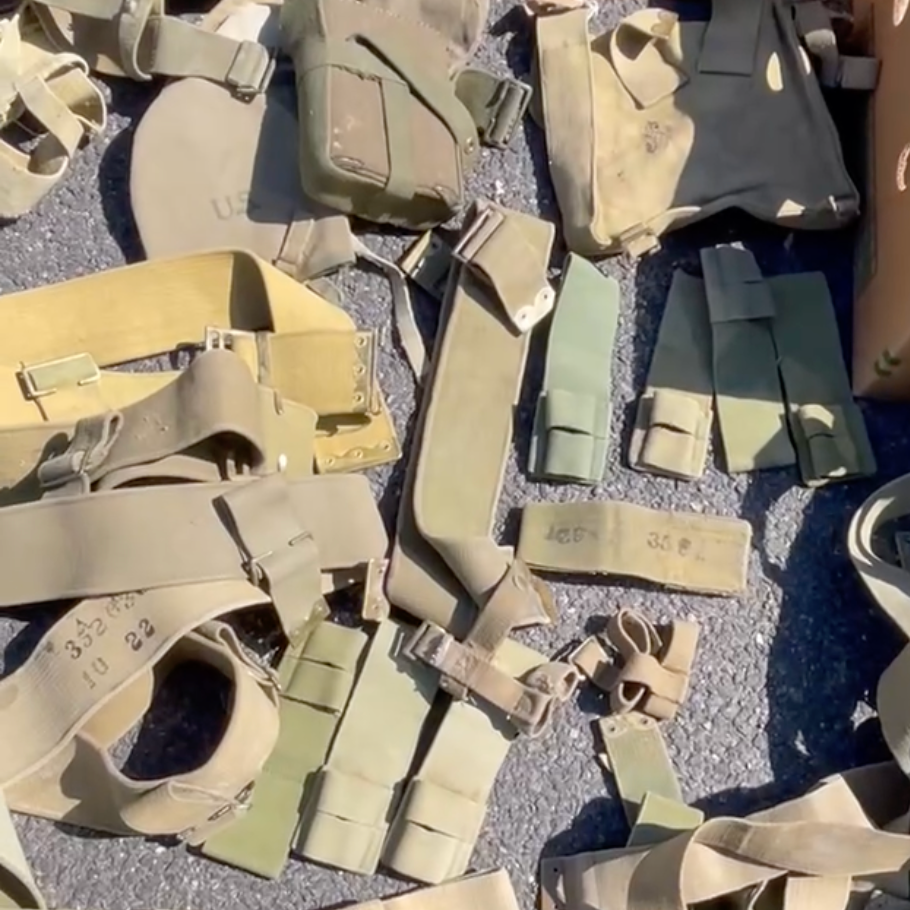

 If you've ever looked at a piece of British military surplus and noticed a long string of numbers such as 8465-99-130-6104, you've found a NATO Stock Number (NSN). I remember spending years assuming it was a random meaningless code that I would never understand, until someone kindly explained it to me.
These numbers appear on everything from webbing and clothing to medical kits, torches and vehicle parts. While they might seem confusing at first, they're actually a simple way of identifying military equipment.
This guide explains what NATO Stock Numbers are, how they work, and why they're useful for collectors.
What is a NATO Stock Number?
A NATO Stock Number (NSN) is a unique 13-digit number used by NATO countries to identify standardised military equipment.
Rather than referring to a manufacturer or brand, an NSN identifies a specific item specification. This allows different NATO countries to order, store and supply identical equipment using a common numbering system.
An NSN is typically written like this:
8465-99-130-6104
Every section of the number has a specific meaning.
A Brief History
Before NATO adopted a common logistics system, each country used its own stock numbering methods.
As NATO expanded after the Second World War, member nations needed a standardised way to identify and supply equipment between allied forces. This led to the creation of the NATO Codification System (NCS), which introduced the NATO Stock Number still used today.
The system now catalogues millions of military items and is used by NATO members as well as a number of partner nations around the world.
How to Read an NSN
A NATO Stock Number consists of 13 digits divided into three sections.
| Section | Meaning |
|---|---|
| First four digits | Federal Supply Class (FSC) |
| Next two digits | National Codification Bureau (Country Code) |
| Final seven digits | Unique item identification number |
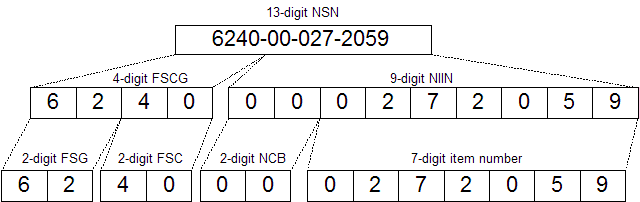
For example:
8465-99-130-6104
- 8465 identifies the type of equipment.
- 99 identifies the United Kingdom as the country that assigned the stock number.
- 1306104 is the unique identifier for that particular item.
Federal Supply Classes (FSC)
The first four digits tell you what type of equipment you're looking at.
There are hundreds of Federal Supply Classes covering every imaginable military item, from aircraft engines to office furniture. Fortunately, collectors generally encounter the same handful of classes time and again.
The table below lists some of the most common.
| FSC | Category |
|---|---|
| 1005 | Small Arms |
| 1010 | Cannons & Heavy Weapons |
| 1095 | Miscellaneous Weapons |
| 5110 | Hand Tools |
| 5120 | Tool Kits |
| 5340 | Hardware & Mounting Equipment |
| 5855 | Night Vision Equipment |
| 5935 | Electrical Connectors |
| 6135 | Batteries |
| 6230 | Portable Lighting |
| 6515 | Medical Equipment |
| 6545 | Field Medical Kits |
| 7210 | Household & Barracks Equipment |
| 7240 | Containers & Storage |
| 7310 | Food Service Equipment |
| 8105 | Bags & Sacks |
| 8315 | Textile Materials |
| 8340 | Tents & Shelters |
| 8415 | Clothing |
| 8420 | Footwear |
| 8440 | Hosiery, Gloves & Insignia |
| 8465 | Individual Equipment (webbing, pouches, bergens, water bottles, etc.) |
| 8470 | Protective Equipment (helmets, body armour, protective gear) |
Collector's Tip: Learning a few common FSC codes makes it much easier to identify unfamiliar surplus items. For example, if an NSN begins with 8415, you're looking at clothing, while 8465 almost always relates to field equipment.
National Codification Bureau (NCB) Codes
The next two digits identify the National Codification Bureau (NCB) that originally assigned the stock number.
One of the biggest misconceptions among collectors is that these digits identify where an item was manufactured.
They don't.
Instead, they identify the country that entered the item into the NATO Codification System.
For British military surplus, you'll most commonly see the code 99.
Below are the NCB codes collectors are most likely to encounter.
Note: This is not a complete list of every NCB code in use. It covers the countries most commonly encountered by military surplus collectors.
| NCB Code | Country |
|---|---|
| 00, 01 | United States |
| 12 | Germany |
| 13 | Belgium |
| 14 | France |
| 15 | Italy |
| 16 | Czech Republic |
| 17 | Netherlands |
| 18 | South Africa |
| 19 | Brazil |
| 20, 21 | Canada |
| 22 | Denmark |
| 23 | Greece |
| 24 | Iceland |
| 25 | Norway |
| 26 | Portugal |
| 27 | Türkiye |
| 28 | Luxembourg |
| 29 | Argentina |
| 30 | Japan |
| 31 | Israel |
| 32 | Singapore |
| 33 | Spain |
| 34 | Malaysia |
| 35 | Thailand |
| 36 | Egypt |
| 37 | South Korea |
| 38 | Estonia |
| 39 | Romania |
| 40 | Slovakia |
| 41 | Austria |
| 42 | Slovenia |
| 43 | Poland |
| 45 | Indonesia |
| 47 | Lithuania |
| 50 | Bulgaria |
| 51 | Hungary |
| 52 | Chile |
| 53 | Croatia |
| 54 | North Macedonia |
| 55 | Latvia |
| 56 | Oman |
| 58 | Finland |
| 59 | Albania |
| 61 | Ukraine |
| 62 | Iraq |
| 63 | Morocco |
| 64 | Sweden |
| 66 | Australia |
| 68 | Georgia |
| 70 | Saudi Arabia |
| 71 | United Arab Emirates |
| 72 | India |
| 73 | Serbia |
| 74 | Pakistan |
| 75 | Bosnia & Herzegovina |
| 76 | Brunei |
| 77 | Montenegro |
| 78 | Jordan |
| 79 | Peru |
| 80 | Colombia |
| 81 | Qatar |
| 82 | Algeria |
| 83 | Ecuador |
| 84 | Ireland |
| 98 | New Zealand |
| 99 | United Kingdom |
British NATO Stock Numbers
British military equipment almost always carries the country code 99.
This simply means the United Kingdom assigned the stock number—it does not mean the item was manufactured in Britain.
Many genuine British Army items have been produced by overseas contractors while still carrying a British NSN.
Likewise, identical equipment may be produced by multiple manufacturers, all sharing the same NATO Stock Number because they meet the same military specification.
Common Misconceptions
“99 means Made in Britain.”
No. It means the United Kingdom assigned the stock number through its National Codification Bureau.
“An NSN tells you who made the item.”
No. The NSN identifies the military specification, not the manufacturer.
“Every military item has an NSN.”
Not always. Prototype equipment, locally purchased items and some specialist equipment may never receive a NATO Stock Number.
“If it has an NSN, it’s definitely military issue.”
Not necessarily. Some commercially available products are manufactured to military specifications and display an NSN. The presence of an NSN alone doesn’t prove an item was issued to the armed forces.
Why NSNs Matter to Collectors
Understanding NATO Stock Numbers can help you:
- Identify the general type of equipment.
- Recognise genuine military-specification items.
- Understand whether an item was catalogued by the UK or another NATO nation.
- Cross-reference equipment with military manuals and parts lists.
- Better understand British and NATO surplus equipment.
Once you know how to read them, NSNs become a useful tool rather than just another string of numbers on a label.
Frequently Asked Questions
Can two different items have the same NSN?
No. An NSN is assigned to one specific item specification. If the specification changes significantly, a new NSN is usually issued.
Why do some labels only show numbers and not “NSN”?
Many manufacturers simply print the 13-digit number without adding the letters “NSN”, as the format is already recognised within military logistics.
Do older British military items have NSNs?
Not always. Equipment produced before NATO standardisation may use earlier British stores reference numbers or service-specific catalogue systems instead.
Is an NSN useful when buying surplus?
Absolutely. While it won’t tell you everything about an item, it can help verify the type of equipment, identify genuine military specifications and make it easier to research or compare similar items.
Further Reading
At The Militaria Shop, we’re collectors ourselves — and we know how much a good reference guide can help. We’ve been building out a library of guides covering everything from German helmet sizes and RZM codes to British uniform sizing and War Department stamps. We add new ones as we get the time, so there’s always something new in the works.
You can find all our guides on the Militaria Collectors Guides page, or browse a selection below.