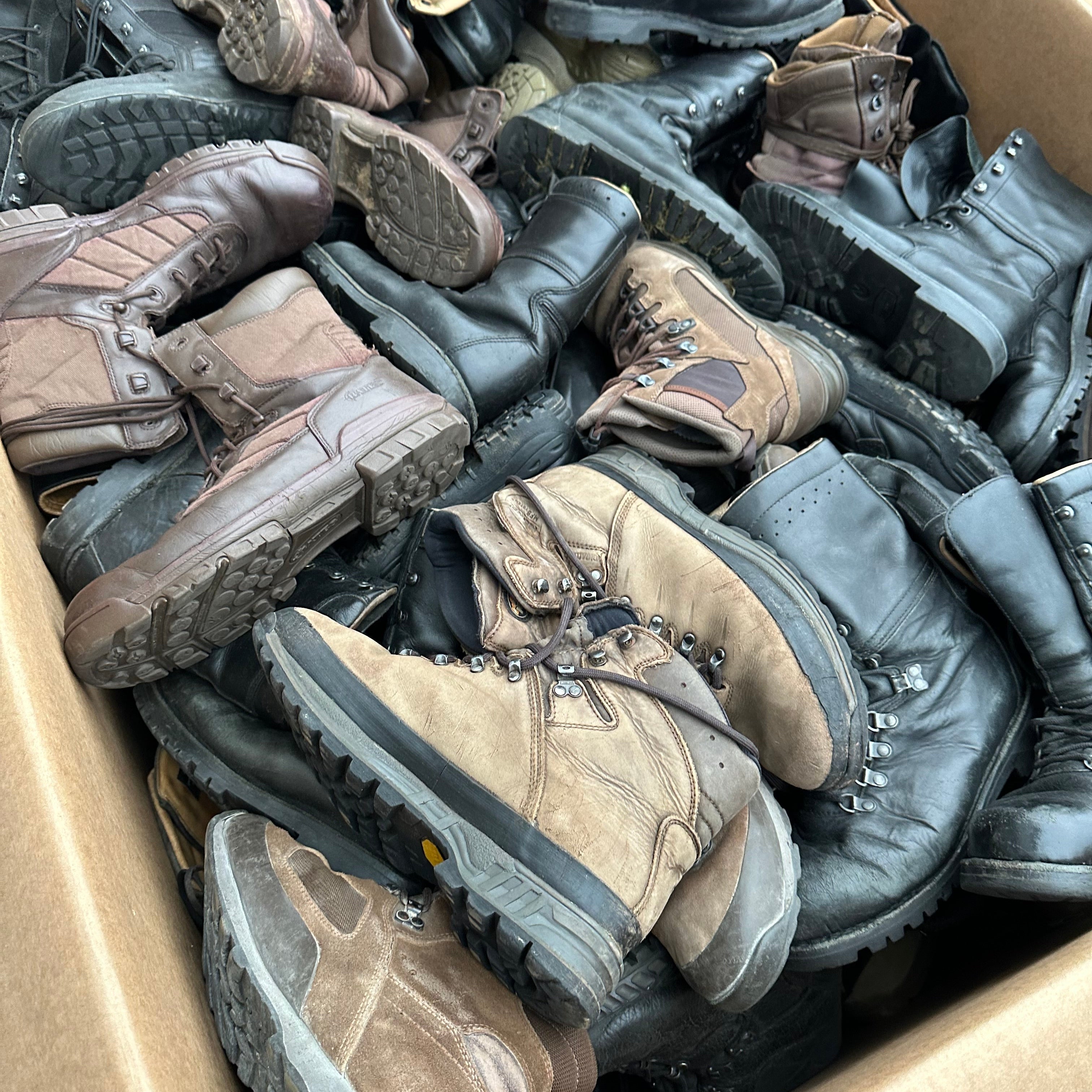

Finding the right size in army combat boots is not always as simple as choosing your usual shoe size. At The Militaria Shop, we stock British, German, Austrian and other modern combat boots. Some have clear size labels, some use European sizes, and others have seen enough service for the original markings to become difficult to read.
This guide explains how to approach UK, EU, US men's and Mondopoint boot sizes, what measurements actually mean, and how to compare a pair of surplus boots when the label has worn away.
The most important rule: foot length, removable insole length, internal sole length and outside sole length are different measurements. Do not use one as a substitute for another.
Contents
- Military boot size conversion and estimated internal sole length guide
- British, German and Austrian size markings
- How to measure your feet
- Sizing boots with worn or missing labels
- Checking the fit
- Common questions
Military boot size conversion and estimated internal sole length guide
This chart provides approximate UK, EU and US men's size conversions, estimated internal sole lengths and approximate Mondopoint length equivalents for military boots, including British, German and Austrian Army footwear. Internal sole length means the measurement inside the boot from heel to toe, not the length of the wearer's foot or the outside sole. It should not automatically be treated as a removable insole measurement. The Mondopoint column describes intended foot length in millimetres, not internal sole length.
Approximate guide only: all chart lengths are estimates, not measurements of every pair we stock. Military boots are made by different manufacturers and in various patterns, so size conversions, fit and internal measurements can vary. This is not a universal or manufacturer-verified sizing chart.
Where an individual pair has been physically measured, the measurements stated in its product description take precedence over this guide. Check which type of measurement is given and compare like with like: an external outsole measurement must not be read as an internal sole length. Use the original marked size and the identifiable maker's guidance alongside the actual pair's measurements. Do not assign a definite size to an unmarked boot from this table alone.
| UK size | EU size (approx.) | Estimated internal sole length | US men's size (approx.) | Mondopoint length (approx., foot length in mm) |
|---|---|---|---|---|
| 3 | 35–36 | 23.5 cm | 4 | 225 |
| 4 | 37 | 24.0 cm | 5 | 235 |
| 5 | 38 | 24.5 cm | 6 | 240 |
| 6 | 39–40 | 25.5 cm | 7 | 250 |
| 7 | 40–41 | 26.5 cm | 8 | 260 |
| 8 | 42 | 27.5 cm | 9 | 270 |
| 9 | 43 | 28.0 cm | 10 | 275 |
| 10 | 44–45 | 29.0 cm | 11 | 285 |
| 11 | 45–46 | 29.7 cm | 12 | 295 |
| 12 | 46–47 | 30.5 cm | 13 | 300 |
| 13 | 47–48 | 31.5 cm | 14 | 310 |
| 14 | 49–50 | 32.5 cm | 15 | 320 |
| 15 | 50–51 | 33.5 cm | 16 | 325 |
How the added conversions were compiled: the US men's column follows the UK-to-US men's conversions shared by the LOWA Professional size chart and Meindl UK size and fit guide for UK sizes 3–15. The approximate Mondopoint length column is an editorial average of LOWA's published foot lengths and Meindl's published Mondopoint lengths at each UK size, rounded to the nearest 5 mm, with halfway values rounded upwards. It is a two-brand reference, not a measured industry-wide average, an official NATO conversion or a guarantee of the marking on a particular boot. It gives the length component only, not a width fitting. The existing EU ranges and internal sole estimates are separate general references, not measurements certified by these manufacturers.
Do not calculate internal room or a toe allowance by subtracting the Mondopoint column from the internal sole column. These independently compiled estimates do not describe one measured boot. Do not replace a surviving factory marking with an averaged value from this table.
Compare measurements from the actual pair you are considering with the same type of measurement from a similar boot that fits you well, using the same measuring method. Do not match your bare foot length directly to the internal sole length column: these are different measurements.
Published references illustrate why measurements must be clearly labelled. A retailer-hosted HAIX sizing reference lists UK 8 with a 28.0 cm insole and a 26.5 cm foot length. Those are different measurement types from the estimated internal sole lengths in the table above, so they should not be used interchangeably.
UK-to-EU conversions can differ too. HAIX's published conversion chart includes UK 10 as EU 45, while LOWA's chart pairs UK 10 with EU 44½. LOWA's length column describes foot length, so it does not verify or disprove the estimated internal sole lengths above.
British, German and Austrian combat boot markings
Start with what is actually marked on the pair, rather than assuming its sizing system from its country of origin. Check the tongue, lining and any surviving printed or stamped markings on both boots. Photograph the complete label where possible, including the maker and model.
British combat boots
If a size is explicitly marked UK, use that as your starting point and check any additional fitting information. A size number alone does not describe the full fit: width, instep shape and the boot's design still matter. Do not automatically treat every number on a military label as a shoe size.
German and Austrian combat boots
When a pair is marked in EU sizes, refer to the identifiable maker's chart rather than relying on a single country-wide conversion. Different models and contracts should not be assumed to fit identically. Retain the original marked size in any description, even when an approximate UK equivalent is also supplied.
What does Mondopoint mean?
Mondopoint is a sizing system based on foot length and width, rather than the outside dimensions of a boot. A three-digit German or NATO/Mondopoint size marking such as 270 generally denotes an intended foot length of 270 mm, or 27 cm, not a 27 cm internal sole length. The actual insole is generally longer to allow room for the foot. It does not mean that the outsole or removable insole should measure 27 cm. Confirm the marking system before interpreting an isolated three-digit number, and use physical measurements from the individual pair rather than treating the marking as an internal measurement.

Different boot designs have different toe shapes, linings and sole profiles. An outside measurement alone cannot describe the space available for your foot.
How to measure your feet for combat boots
- Place a sheet of paper on a firm, level floor with one edge against a wall.
- Wear the type of socks you intend to use with the boots.
- Stand with your heel gently against the wall, keeping your weight on your foot.
- Ask someone to mark the end of your longest toe, keeping the pencil upright.
- Measure the distance from the wall edge to the mark in millimetres.
- Repeat for the other foot and use the longer measurement when consulting the maker's chart.
Follow the instructions attached to the particular chart. Do not add an arbitrary allowance and then treat that enlarged figure as your measured foot length. A chart headed “foot length” is not asking for the length of an insole or the internal sole. Likewise, the estimated internal sole length table above is not a foot-length chart.
How to size army boots when the labels have worn away
When the original size is unreadable, measurements can help narrow the possibilities, but they cannot recreate the original size with certainty. Be clear about exactly what has been measured.
1. Compare the removable insole, where available
If the insole comes out easily, measure it from its rearmost heel point to its furthest toe point without stretching it. Compare it with the removable insole from a similar boot that already fits you well, using the same measuring method. Do not force out a glued-in footbed.
This is a comparison aid, not a guaranteed size conversion. Insoles may have been replaced or trimmed, and a shaped footbed is not necessarily the same length as the usable space inside the boot. Width, thickness and toe shape matter too. Record the measured length of the actual insole rather than substituting the estimated internal sole length from the table.
2. Record the outside sole length accurately
Measure the external sole from the furthest point of the heel to the furthest point of the toe in a straight line. Do not wrap a tape around the upturned toe or follow the curve of the tread. Describe the result as external outsole length.
Compare that figure with a well-fitting boot of the same model and sole design wherever possible. A comparison between unrelated models is much less useful because their sole overhangs and construction can differ. Do not use an external sole measurement in the internal sole length table.
3. Do not subtract a fixed amount
There is no reliable universal rule such as “subtract 2 cm from the outsole to get the foot size”. A thick toe bumper, projecting heel or different last can change the outside dimensions without providing the same change in internal room.
For example, an external sole measurement of 30 cm does not establish that the boot fits a 30 cm foot, has a 30 cm insole, or is a particular UK size.
4. Keep estimates separate from marked sizes
A useful description distinguishes an original marked size from an estimated fit. Where only measurements are available, compare like with like and ask about the individual pair before buying. Do not present an estimated UK size as if it were a surviving factory marking.
Checking the fit of surplus combat boots
Try boots with your intended socks, seat your heels properly and lace them evenly. Your toes should not be cramped or forced against the front, and your heels should not slide excessively. Walk indoors on a clean surface and check for pressure across the forefoot, instep and ankle.
Length is only part of the fit. A boot can be long enough yet too narrow, or wide enough yet too loose around the heel. Thick replacement insoles and heavy socks can also change the available room. Do not rely on breaking in a boot to solve a clearly unsuitable length or painful fit.
For surplus footwear, inspect the pair itself as well as the size: check the lining, footbeds, stitching and soles, and make sure both boots carry matching markings where these survive.
Common combat boot sizing questions
Is EU 43 always a UK 9?
No. HAIX's published chart includes that conversion, while LOWA's published reference pairs UK 9 with EU 43½. The identifiable maker's chart and the actual pair should take priority over a general conversion.
Can I work out a UK boot size from the outside sole length?
Not accurately from that measurement alone. It is most useful for comparing boots of the same model. Always distinguish an outsole measurement from an insole, internal sole or foot measurement.
Should I automatically buy combat boots one size larger?
No blanket rule will suit every boot and foot. Start with the maker's guidance, your measured foot length and the socks you intend to wear, then check the fit.
What should I ask when a boot's label is missing?
Ask whether the supplied measurement is external sole length, removable insole length or an internal measurement, how it was taken, and whether the maker or model can be identified. Compare it with the same measurement from boots you already own.
Choosing a pair from The Militaria Shop
Our stock includes British, German, Austrian and other modern combat boots. If you are unsure about an individual pair, contact us with the listing details, your usual boot size and any comparable measurements. A clear measurement is more useful than an unexplained number, especially when an original label has worn away.
Sources and sizing references
The US men's conversions and approximate Mondopoint length equivalents use the LOWA Professional size chart and Meindl UK size and fit guide, consulted on 20 November 2026. The averaging and rounding method is explained beneath the table. These are editorial approximate equivalents, not a sizing chart endorsed by either brand.
The estimated internal sole length table is an approximate general reference, not a manufacturer-certified chart, and is not attributed to LOWA or HAIX. The figures have not been verified across all models. For the specific comparisons and fitting information discussed above, see the retailer-hosted HAIX insole and foot-length reference; HAIX UK/EU conversions; LOWA Professional size chart; LOWA UK fit recommendations; HAIX fitting advice; and ISO 9407 Mondopoint reference, 1991 edition. References for one manufacturer or model are not guarantees for every surplus pair.
More Militaria Collectors Guides
We are collectors ourselves, and our Militaria Collectors Guides library brings together practical references covering German helmet sizes, RZM codes, British uniform sizing and War Department stamps. Explore the guides below for more help identifying and understanding your collection.